
Ubisoft Montpellier — Prince of Persia : The Lost Crown
Reinventing the map of a Metroidvania game to bring genuine innovation — without betraying the codes of a cult genre.
Context
The only external designer on a AAA development team
Through UX République, I was embedded directly within the Ubisoft Montpellier Studio development team — the only external contributor working alongside game designers, developers, and marketing teams on what would become Prince of Persia: The Lost Crown.
The project took place during the Covid pandemic, which forced a full shift to remote work. Discovery workshops, ideation sessions, and co-design sprints — traditionally held in person — were entirely rethought on Miro, while maintaining the same level of collaborative rigor.
Challenge
Innovate within a genre without betraying it
Challenge 01
Rethink the traditional Metroidvania map and introduce meaningful interaction innovations.
Challenge 02
Preserve the deep codes and identity of the genre, as expected and cherished by players.
Challenge 03
Prototype a controller-based interaction to enable realistic playtesting during the design phase.
Discovery
Understanding a genre before reinventing it
Before designing anything, it was essential to deeply understand what makes a Metroidvania what it is — the map as a tool for memory, exploration, and progression. A thorough genre analysis preceded all design workshops.
Discovery and co-design sessions brought together developers, game designers, and marketing teams on Miro. The challenge wasn't just defining what to design, but aligning a cross-functional team on what could be innovated without breaking the implicit contract with genre fans.
Process
From Design Sprint to controller-in-hand prototype
Genre analysis
In-depth study of Metroidvania conventions — map mechanics, exploration, progression — to identify what must be preserved and where innovation was possible.
Design Sprint & remote co-design
Ideation workshops on Miro with cross-functional teams to define new map interactions and align everyone around a shared vision.
Map design (codename: Memory)
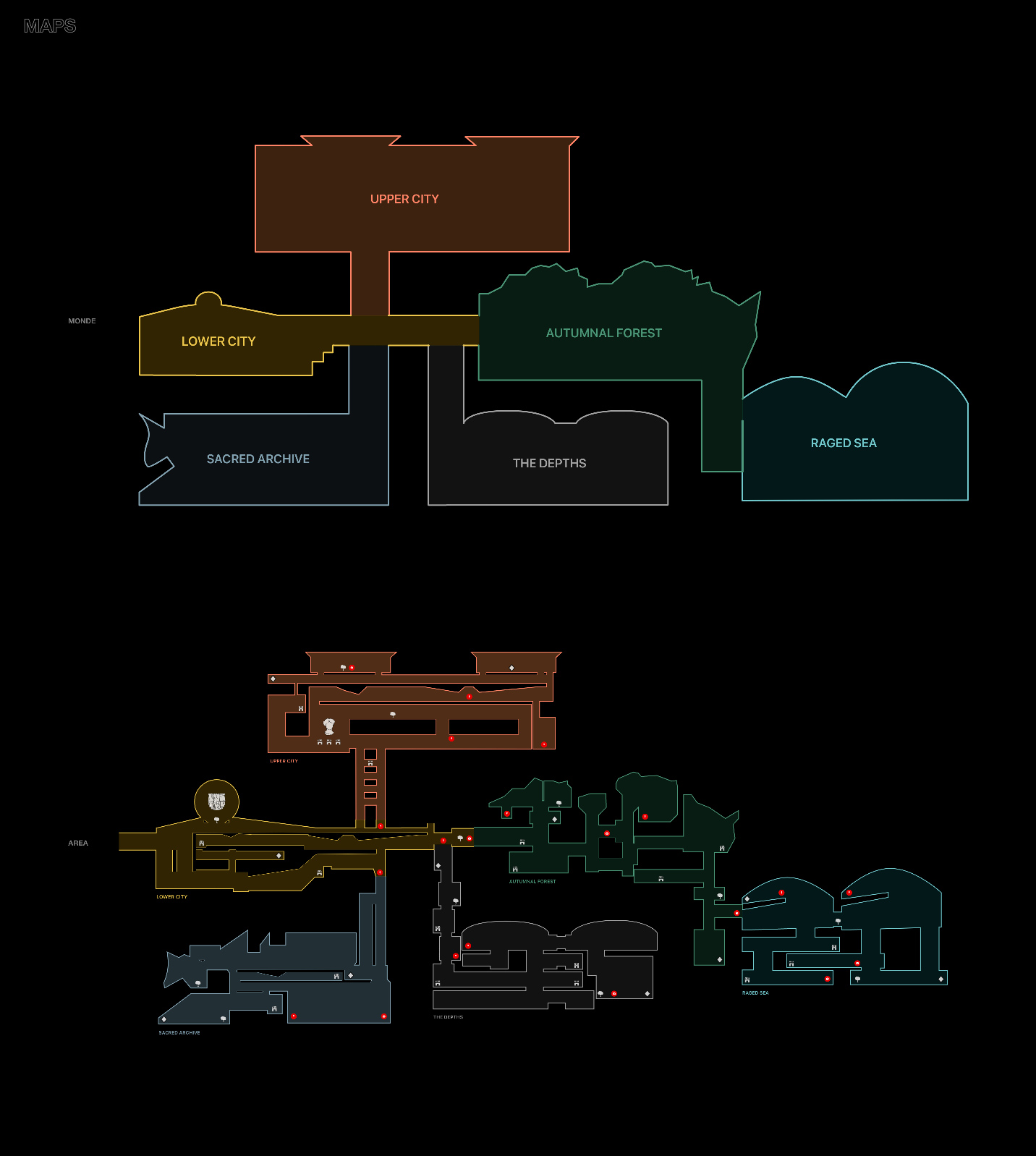
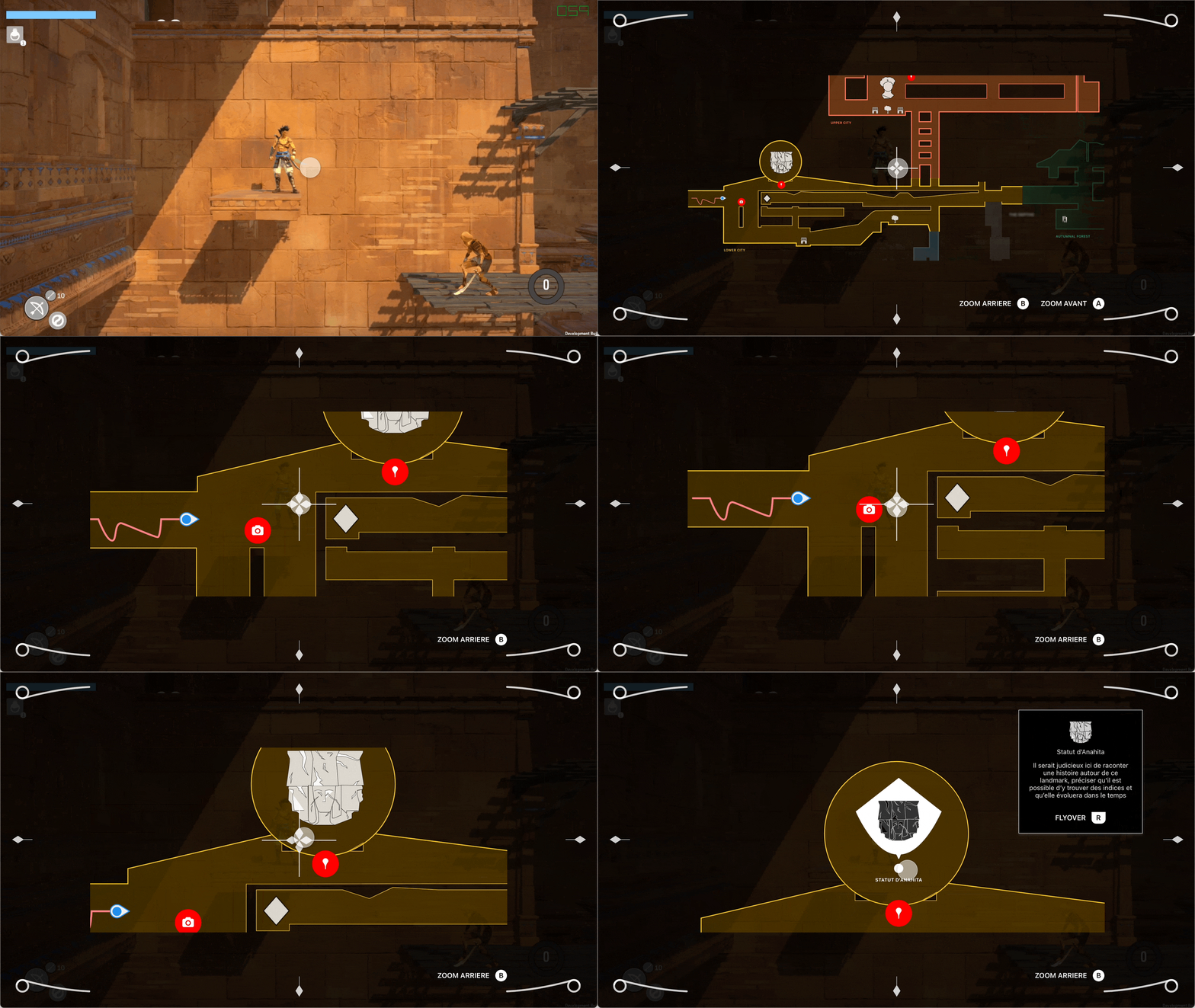
Design of zoom levels, markers, area layouts, and multiple interactive elements across the map.
Adobe XD + Joy-Con prototype
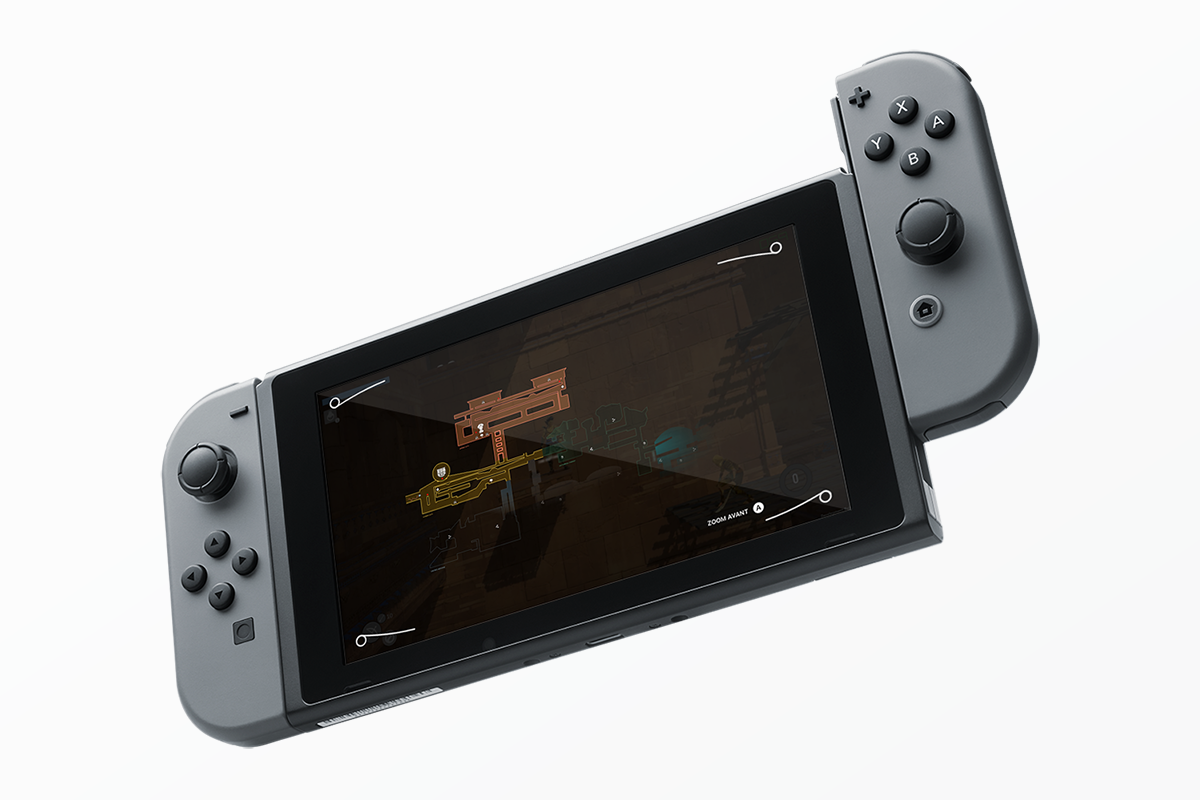
Built an interactive prototype connected via Bluetooth to Joy-Con controllers, enabling full simulation of map interactions in real play conditions.
Internal playtesting
Concept validation with the team and Ubisoft's internal UX Research lab to iterate on interactions before handoff to development.
Solution
A reinvented Metroidvania map, playable with a controller
The “Memory Maps” concept: a map that preserves all the expected visual markers of the genre, enriched with new zoom levels and original interactions — all testable in real conditions through a Joy-Con prototype.
Zoom levels
Multiple map reading levels to navigate between global overview and detailed area exploration.
Enhanced interactions
Markers, annotations, and multiple interactive elements for a living map that players can personalize.
Controller prototype
Adobe XD prototype connected via Bluetooth to Joy-Con controllers for real-condition playtesting from the design phase.
Takeaways
What I learned
Designing for a game studio is a different world — Being the only UX profile among AAA game designers and developers requires fast adaptation to a different vocabulary, set of constraints, and working culture.
The prototype as a technical conviction tool — Connecting Joy-Con controllers to Adobe XD wasn’t part of the brief. It became a strength: the controller-in-hand prototype made the concept immediately understandable and testable by the entire team.
Innovating in a genre means deeply understanding it first — The Metroidvania analysis phase was just as important as the design phase. You can’t reinvent what you don’t fully understand.
Remote can be an accelerator — The Covid constraint forced a rigor in remote workshop facilitation that proved just as effective — and often more structured — than in-person sessions.
The concept made it into the final game — The map in Prince of Persia: The Lost Crown, praised by the community for its complexity and screenshot marker system, is the one I designed. A rare and meaningful validation: seeing your work appreciated by thousands of players who don’t know it came from a UX process.
Interfaces
A look at the Memory Maps concept
Overview map, zoom levels, and interactive prototype — the visuals below illustrate the different states of the map designed for playtesting.